
Tool profile
Mercurial SCM
Mercurial is a free, distributed source control management tool.
What is Mercurial SCM?
Mercurial SCM is a free, distributed source control management tool that belongs in the Code Collaboration category. It is a strong fit for development teams working on large-scale projects who need reliable speed and performance with large repositories and complex histories. Mercurial stands out for its simplicity, offering a simpler command set and a more intuitive branching model compared to Git, making it easier for new users to learn.
While the provided facts do not list pricing plans or costs beyond its free status, users should check their pricing page for current details. Additionally, Mercurial is available on the Web and supports Windows, macOS, and Linux operating systems, ensuring versatility for teams using diverse environments.
Features
Performance
Mercurial is known for its speed and performance, especially with large repositories and complex histories. It is designed to be fast and efficient, which makes it suitable for large-scale projects.
Simplicity
Mercurial has a simpler command set compared to other SCMs like Git. The straightforwardness of its commands can make it easier to learn and use, particularly for new users.
Cross-platform Support
Mercurial is a cross-platform tool that works well on a variety of operating systems including Windows, macOS, and Linux. This makes it versatile for development teams using different environments.
Strong Documentation
Mercurial offers comprehensive and well-structured documentation which can be very helpful for both beginners and advanced users. The documentation covers a wide range of topics from basics to more complex usage.
Branching Model
Mercurial uses a simpler and more intuitive branching model compared to Git. This can make branch handling more straightforward, reducing the complexity for developers.
Screenshots
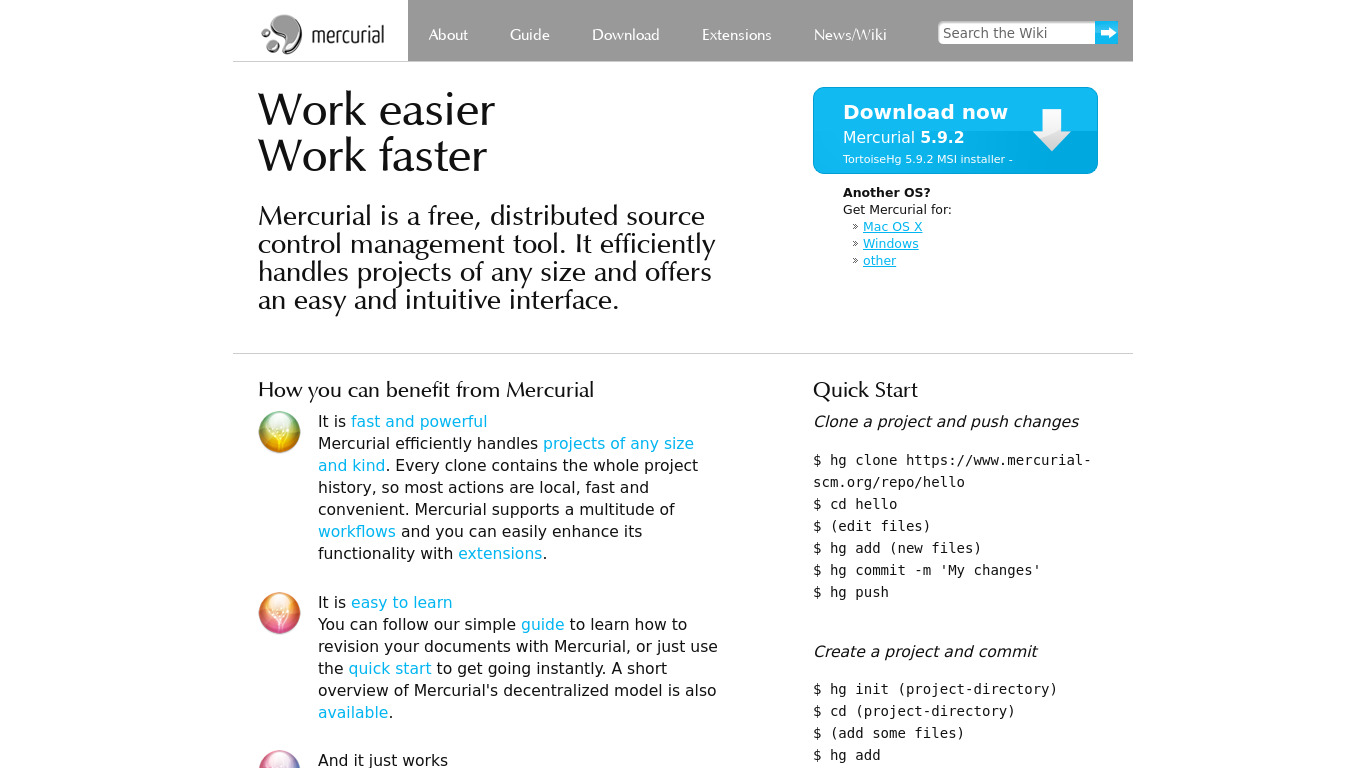
Mercurial SCM vs. its alternatives
| Mercurial SCM |  Tower |  Git |  Perforce |  GitKraken | |
|---|---|---|---|---|---|
| Pricing | — | — | Open source | — | — |
| Platforms | |||||
| Listed features | 5 | — | 7 | — | 5 |
Frequently asked questions
Is Mercurial SCM free?
Yes, Mercurial is a free, distributed source control management tool. Check their pricing page for current plans or any additional details not listed in the facts.
What is Mercurial SCM used for?
Mercurial SCM is used for code collaboration as a distributed source control management tool. It is particularly suitable for large-scale projects due to its speed and performance with large repositories.
What operating systems does Mercurial SCM support?
Mercurial SCM features cross-platform support and works well on Windows, macOS, and Linux operating systems.
How does Mercurial SCM's branching model work?
Mercurial uses a simpler and more intuitive branching model compared to Git, which makes branch handling straightforward and reduces complexity for developers.
What is the command set of Mercurial SCM like?
Mercurial has a simpler command set compared to other SCMs like Git, making it easier to learn and use, especially for beginners.
What are the best alternatives to Mercurial SCM?
Top alternatives to Mercurial SCM include Git, Tower, and GitKraken. You might prefer these alternatives if you specifically want to use Git or its associated GUI clients rather than Mercurial.
Alternatives to Mercurial SCM
Read the full comparison →Git
Git is a free and open source version control system designed to handle everything from small to very large projects with speed and efficiency. It is easy to learn and lightweight with lighting fast performance that outclasses competitors.

GitHub Desktop
GitHub Desktop is a seamless way to contribute to projects on GitHub and GitHub Enterprise.



Atlassian Bitbucket Server
Atlassian Bitbucket Server is a scalable collaborative Git solution.